
skip to main content
Subcontractors Contact Us
close button
Logo Light Logo Dark Logo Sticky Logo Mobile Logo
search button
  • Who We Are

    Our Story

    We are a family of builders building amazing spaces across the US, Canada, UK, and Ireland.

    Learn More >

    History

    Founded in 1971, we have grown into an organization made up of over 5,700 employees across 54 offices.

    Learn More >
    • Safety
    • Innovation
    • Quality
    • Compliance
    • Awards
    • Corporate Responsibility
  • What We Do

    Projects

    ST. PATRICK`S CATHEDRAL

    St. Patrick’s Cathedral, a New York City landmark building and one of the most revered Catholic Churches in the United States, underwent a major restoration and conservation project.

    Learn More about this project >
    View All Projects >

    Sectors

    Our Focus Areas

    • Aviation
    • Broadcast-Media
    • Building Repositioning
    • Corporate Base Building
    • Corporate Interiors
    • Corrections
    • Cultural/Religious
    • Education
    • Financial
    • Government
    • Healthcare
    • Hospitality
    • Industrial
    • Justice
    • Law
    • Life Sciences
    • Mission Critical
    • Multi-Unit Residential
    • Public Safety
    • Retail
    • Sports & Entertainment
    • Technology
    View all Sectors >

    Expertise

    • Building / Site Evaluation
    • Construction Management
    • Construction Procurement Solutions
    • Elevator Construction Consultants
    • Enterprise Solutions
    • Facilities Construction Services
    • Mass Timber Construction
    • Preconstruction
    • Sustainability & Wellness
    • Technology & Innovation
    • Virtual Design & Construction
    Learn more about our Expertise >
  • People

    Careers

    No matter the type of project, complexity or client, one thing remains constant—people do the work. Learn more about our career opportunities.

    Learn More >

    Leadership

    Meet the experts who lead our people and organization.

    Learn More >

    Community

    We care about each other and are committed to making a positive impact where we live and where we work.

    Learn More >
  • News

    STOBG In The News

    Stay informed and stay connected. View the latest company announcements, employee achievements, and leadership highlights.

    Learn More >

    STOBG Insights Magazine

    Get inspired by the latest issues on project renovations, designs, company commemorations, and collaborations.

    • Read the Magazine>
    More News >

    STOBG Podcast

    Connect and listen to construction professionals and leaders one conversation at a time.

    Learn More >

    Thought Leadership

    What’s next in construction? From trends to data, find out more from our experts.

    Learn More >
  • Companies
    • Abbott Construction
      Abbott Construction Abbott Construction company logo
    • Ajax
      Ajax Ajax company logo
    • BCCI
      BCCI BCCI company logo
    • Govan Brown
      Govan Brown Govan Brown company logo
    • Layton
      Layton Layton company logo
    • LF Driscoll
      LF Driscoll LF Driscoll company logo
    • STOMC
      STOMC STOMC company logo
    • Pavarini Northeast
      Pavarini Northeast Pavarini Northeast company logo
    • Pavarini McGovern
      Pavarini McGovern Pavarini McGovern company logo
    • RC Andersen
      RC Andersen RC Andersen company logo
    • Structure Tone
      Structure Tone Structure Tone company logo
    • Structure Tone International
      Structure Tone International Structure Tone International company logo
    • Structure Tone Southwest
      Structure Tone Southwest Structure Tone Southwest company logo
  • Contact
  • Find Us
  • WHO WE ARE
    • Our Story
    • History
    • Safety
    • Innovation
    • Quality
    • Compliance
    • Awards
    • Corporate Social Responsibility
  • WHAT WE DO
    • Projects
    • Sectors
      • Broadcast & Media
      • Building Repositioning
      • Corporate Base Building
      • Corporate Interiors
      • Corrections
      • Cultural/Religious
      • Education
      • Financial
      • Government
      • Healthcare
      • Hospitality
      • Industrial
      • Justice
      • Law
      • Life Sciences
      • Mission Critical
      • Multi-Unit Residential
      • Public Safety
      • Retail
      • Sports & Entertainment
      • Technology
    • Expertise
      • Building Repositioning
      • Building / Site Evaluation
      • Commissioning
      • Construction Management
      • Construction Procurement Solutions
      • Elevator Construction Consultants
      • Facilities Construction Services
      • Mass Timber
      • Preconstruction
      • Sustainability & Wellness
      • Technology & Innovation
  • PEOPLE
    • Careers
      • Apply
    • Leadership
    • Community
  • News
    • STOBG Insights
    • STOBG In The News
    • Podcast
    • Thought Leadership
  • Companies
    • Abbott Construction
    • Ajax Building Company
    • BCCI Construction
    • Govan Brown
    • Layton Construction
    • LF Driscoll
    • STO Mission Critical
    • Pavarini North East
    • Pavarini McGovern
    • RC Andersen
    • Structure Tone
    • Structure Tone International
    • Structure Tone Southwest
  • Contact
  • FIND US
back Button
LOCAL LAW 154: NYC Building Electrification Explained | STO Building Group (STOBG)
Buildings are the largest source of greenhouse gas emissions in New York City. To reduce manmade greenhouse gas emissions, NYC City Council has banned the burning of fossil fuels in any new building or any building undergoing a major renovation, starting in 2024.
42124
wp-singular,post-template-default,single,single-post,postid-42124,single-format-standard,wp-theme-onyx,wp-child-theme-onyx-child,vcwb,ajax_fade,page_not_loaded,,onyx child-child-ver-1.0.0,onyx-ver-1.4.1, vertical_menu_with_scroll,smooth_scroll,side_menu_slide_with_content,width_470,wpb-js-composer js-comp-ver-9.0.1,vc_responsive
LOCAL LAW 154: NYC Building Electrification Explained

LOCAL LAW 154: NYC Building Electrification Explained
June 17, 2022
Share
  • Small Icon
  • facebook
  • twitter
  • linkedin

Local Law 154 NYC Building Electrification

Written by Brooks McDaniel, Senior Vice President, Building Repositioning, STO Building Group (STOBG)

Buildings are the largest source of greenhouse gas emissions in New York City. To reduce manmade greenhouse gas emissions, NYC City Council has banned the burning of fossil fuels in any new building or any building undergoing a major renovation, starting in 2024.

The bill prohibits the combustion of “a substance that emits 50 kilograms or more of carbon dioxide per million BTUs of energy in any new building or any building that has undergone a major renovation.” This includes natural gas, fuel oil, coal, and other fossil fuels. New or substantially renovated buildings must rely on electricity for heat, domestic hot water, and domestic cooking. A similar bill has been proposed by NY state lawmakers, and legislation is in the works in other cities and states around the country.

Will this bill reduce greenhouse gas emissions?
Eventually yes, but it will take time. Currently, 85% of NYC’s power is produced from burning fossil fuels, with only 15% coming from renewable sources. The reverse is true across NY state, with 88% coming from clean resources, but the existing transmission lines do not have enough capacity to bring much of this clean energy to the city. So, for now, NYC will continue to rely on its 24 power plants, which burn natural gas and/or fuel oil.

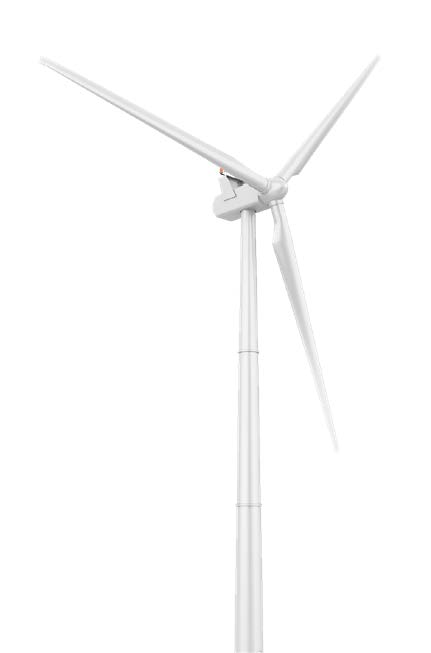
However, the city has committed to transforming NYC’s electricity grid into one powered by zero-emissions resources by 2040. To do this, there are plans in place to build large-scale offshore wind farms, extensive upstate solar arrays, new transmission capacity, as well as large energy storage facilities to add resiliency and redundancy to the grid.

Can the grid handle it?
Building electrification poses no immediate risk to the grid. NYC’s winter power demand could grow by 42% before exceeding summer peak demand. A detailed study of grid readiness is due to be released by mid-2023.

When does this law take effect?
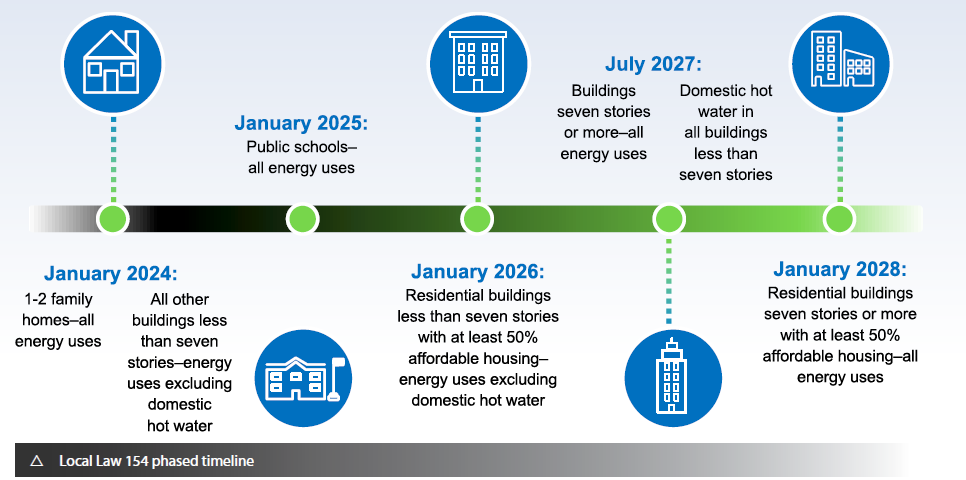
The implementation dates are phased to allow time for the market to ramp up with more products, training, and design strategies.

How will I heat and cool my new building?
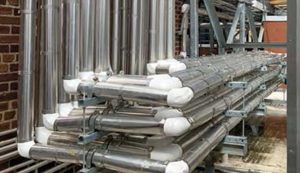
Air-source heat pumps will be the system of choice for heating and cooling most large buildings. These electrically powered units are emissions free and work in a wide range of exterior temperatures. A four-pipe distribution system allows simultaneous heating and cooling of different zones of the building and allows for energy recovery on the return water which enhances the system efficiency. Electric heat pumps operate at lower temperatures than traditional boilers and chillers, typically 95°-105° for heating water and 55° for chilled water. The lower water temperature requires the use of larger fan coils than high temperature systems.

A large building will have multiple heat pumps located either on the roof, or on screened open-air mechanical floors (breezeways). Skyscrapers taller than 500ft are likely to require two or more openair mechanical floors due to the size and number of heat pumps, and the space restrictions on a tower roof. There will be some space efficiencies created on occupied floors since there will be no boiler flue rising through the building.

The installation cost will be higher than a building with a gas-fired boiler, since large heat pumps are more expensive than traditional boilers. However, prices are likely to come down in the future. There is extra cost associated with the additional plumbing related to thermal loops, and due to the need for the larger fan coils as noted above.

Lastly, the building’s electrical power requirements will be at least double that of a building with gas boilers, which will also increase construction cost.

The operation cost will be roughly the same as a building with a gas-fired boiler currently. In the coming years, gas-fired and steam boilers may become more expensive to operate as the city switches over to electrified buildings. Utility costs for gas and steam are expected to rise due to high overhead costs with fewer customers. And building owners who don’t switch to all electric heat pumps will be penalized for excessive emissions starting as soon as 2025, due to Local Law 97.
Local Law 154 NYC Building Electrification

What other heating and cooling systems could I consider?
For buildings less than seven stories, variable refrigerant flow (VRF) system is a viable and increasingly common alternative. These are smaller than air-towater heat pumps and circulate refrigerant from a series of roof-mounted compressors to the interior areas for heating and cooling. Each unit is individually piped to the zone being served. VRF systems are far cheaper to purchase and install than airto-water heat pumps, however, they are likely to have a shorter lifecycle due to increasing restrictions on refrigerants that are harmful to the environment. As the current refrigerants are phased out, the entire system will have to be replaced.

Lastly, air-to-air heat pumps are likely to be a common supplemental system in large buildings for tempering incoming air for dedicated outside air systems (DOAS), as required by NYC building code.

How will I make domestic hot water?
Traditional electric hot water heaters using resistance coils are common in single family homes but do not exist on larger scales for multifamily residential buildings or large commercial buildings.
Air-sourced heat pumps and water-to-water heat exchangers will be the common solution for domestic water in larger buildings. Additionally, some portion of domestic hot water capacity could come from a water-to-water geothermal heat pump, although this is likely to be limited.

Lastly, if I file a permit for my new large building prior to the deadline, can I use gas?
Technically, yes—but there is a risk. The lifespan of a building is longer than the systems within it. When you renovate your building in the future, you will likely be required to convert to electric heating and cooling. Many of our clients are already making the switch in advance of the deadline.
Local Law 154 NYC Building Electrification

Tags:
Structure Tone New York


Our Family of Builders

  • Abbott Construction
  • Ajax
  • BCCI
  • Govan Brown
  • Layton Construction
  • LF Driscoll
  • STO Mission Critical
  • Pavarini North East
  • Pavarini McGovern
  • RC Andersen
  • Structure Tone
  • Structure Tone International
  • Structure Tone Southwest

Who We Are

  • Our Story
  • History
  • Leadership
  • Corporate Responsibility

Helpful Links

  • Careers
  • Projects
  • Sectors
  • Expertise
  • Subcontractors
  • CMiC Partner Collaboration Portal
  • Modern Slavery Statement

Industry Insights

  • Insights Magazine
  • Podcast
  • Thought Leadership

Contact Us

Locations

Business Development
bd@stobuildinggroup.com
Careers
careers@stobuildinggroup.com
Press
press@stobuildinggroup.com

STO Building Group (STOBG) is a Family of Builders.

STO Building Group (STOBG) is a leader in commercial construction management. We draw on each other’s strengths to deliver expert services in preconstruction, sustainable construction, virtual design and construction, and more.


SUBSCRIBE TO STOBG INSIGHTS MAGAZINE

  • message

copyrights By continuing with this site you consent to the use of cookies.
Copyright STO Building Group (STOBG) 2026.
Privacy Policy | Terms of Use | Cookie Policy | Sitemap

Instagram
Facebook
LinkedIn
YouTube
Twitter
Podcast
Spotify

  • message

Privacy Rights Request Form

We are committed to protecting your personal information. You may use this form to submit a request regarding your personal data under applicable privacy laws. Depending on your location and relationship with STO Building Group (STOBG), you may have the right to request access to, correction or deletion of, or restrictions on how we use your data. We may contact you to verify your identity before processing your request.