United States

Podcast Episode
Ask the Expert: Think Before You Build: How VDC Changes the Game with Jon Ferguson
November 13, 2026
What if some of the most important construction decisions happen before a project even breaks ground? In this episode of Ask the Expert, Jon Ferguson, Vice President of VDC at Layton Construction, explores how bringing virtual design and construction (VDC) and preconstruction teams together early can help reduce risk, improve cost certainty, and deliver more predictable project outcomes. The takeaway? Less guesswork, fewer surprises, and a stronger foundation for project success.
Key Takeaways
- Early collaboration between virtual design and construction (VDC) and preconstruction teams helps improve cost certainty, reduce risk, and create more predictable project outcomes.
- VDC delivers the greatest value when introduced during conceptual design and early planning, before major budget, schedule, and design decisions are finalized.
- Digital modeling, simulation, and visualization allow teams to identify coordination issues, sequencing challenges, logistics constraints, and constructability concerns before they impact construction.
- Integrating VDC and preconstruction enables teams to evaluate prefabrication opportunities, procurement strategies, and project logistics alongside cost and schedule considerations.
- Early VDC involvement can help align project designs with client budgets, as demonstrated by a project where massing models were developed to support a developer’s financial pro forma.
- Collaborative planning improves the transition from preconstruction to operations by providing field teams with coordinated strategies developed from the beginning of a project.
- VDC visualization strengthens client confidence by helping owners understand how projects will be constructed, what challenges exist, and how proposed solutions affect cost and schedule.
- Emerging technologies, including reality capture, AI-enabled tools, data analytics, and 3D logistics planning, are helping teams turn project information into actionable insights.
- VDC is not limited to large-scale, ground-up construction. Services such as Scan-to-BIM can support tenant improvements, renovations, vertical expansions, and smaller-budget projects.
- Successful integration requires a collaborative culture where estimating, VDC, operations, and trade partners share information, align on objectives, and prioritize better decisions over additional deliverables.
Highlights In This Episode
VDC and preconstruction have the greatest opportunity to influence project costs and schedules during early planning. By working as one integrated team, they can replace assumptions with digital modeling, simulation, and informed decision-making.
VDC should be involved as early as conceptual design, when teams can evaluate site logistics, phasing, prefabrication, constructability, and schedule impacts before critical decisions are locked in. Early involvement also helps establish appropriate VDC requirements and budgets.
Identifying risks digitally allows teams to address coordination issues, sequencing challenges, and scope gaps before they affect budgets or schedules. Jon shares an example of working with a developer before an architect was hired, using massing models and financial considerations to develop a feasible project plan.
When teams collaborate from the beginning, estimating, scheduling, visualization, and constructability reviews inform one another throughout design development. This continuous coordination helps operations teams begin construction with a more complete and coordinated strategy.
When VDC is introduced after major design, budget, and schedule decisions have been made, its role becomes more reactive than proactive. Projects may miss opportunities to improve logistics, procurement, prefabrication, and constructability that could have been addressed earlier.
VDC helps clients better understand the how, why, and when of construction. Jon highlights a hospital replacement project where VDC, preconstruction, design partners, and trade contractors evaluated foundation and shoring options to identify solutions that minimized disruption and reduced costs.
Emerging technologies, including AI-enabled tools, reality capture, progress tracking, 3D logistics planning, and data analytics, are improving project visibility and coordination. Jon emphasizes that the true value of technology lies in helping teams make better decisions, not simply generating more models.
VDC can provide significant value on smaller and fast-paced projects, including tenant improvements, renovations, and vertical expansions. Tools such as Scan-to-BIM help teams understand existing conditions and identify solutions suited to each project’s needs.
Jon encourages teams to involve VDC in planning and risk discussions, focus on project outcomes rather than deliverables, and establish a shared source of information. Successful projects bring estimating, VDC, operations, and trade partners together around common goals from the outset.
Closing Summary
In this episode of the Ask the Expert series, Jon Ferguson, Vice President of VDC at Layton Construction, explores how early collaboration between virtual design and construction (VDC) and preconstruction teams can improve project planning, reduce risk, and create more predictable construction outcomes. The discussion highlights why VDC should be treated as a proactive planning resource rather than a reactive coordination tool. Through real-world project examples, Jon demonstrates how digital modeling, constructability reviews, and collaborative decision-making can help teams identify challenges early, evaluate potential solutions, and better align project designs with client expectations, budgets, and schedules. Jon also examines how emerging technologies, reality capture, and data-driven insights are expanding VDC’s role across projects of varying sizes and complexities. From large healthcare facilities to smaller renovation projects, the episode reinforces that successful outcomes depend on bringing the right expertise together at the right time. Ultimately, the conversation underscores a central message: the greatest value of VDC isn’t simply creating digital models—it’s using those models and the information they provide to make smarter decisions before construction begins.
Host


Jon Ferguson
Vice President, VDC
Layton Construction
Jon Ferguson is the Vice President of Virtual Design and Construction (VDC) at Layton Construction. With a career that began as a CAD drafter in an architectural design studio, Jon has steadily advanced through the ranks of the construction and design industry. His early exposure to architectural drafting laid a strong foundation for his expertise in digital construction technologies, and over the years, he has mastered a wide array of design software tools that are now integral to modern construction practices.
Throughout his career, Jon has been a passionate advocate for innovation in construction, particularly through the integration of VDC methodologies. At Layton Construction, he leads a team dedicated to enhancing project outcomes through advanced modeling, coordination, and reality capture technologies. His leadership has been instrumental in streamlining workflows in new technology like AI, improving collaboration across disciplines, and reducing costly errors during construction. Jon’s approach emphasizes the importance of continuous learning and adaptability, qualities that have helped him stay at the forefront of a rapidly evolving industry.
In addition to his professional achievements, Jon is committed to mentoring the next generation of construction professionals. He frequently shares his insights with students and young professionals, encouraging them to embrace technology and develop a strong foundation in both design and construction principles. His journey from a CAD drafter to a vice president serves as an inspiring example of how dedication, curiosity, and a willingness to evolve can lead to a fulfilling and impactful career in the built environment.
Similar Episodes
Next-Level Building: Drones, AI, and Reality Capture

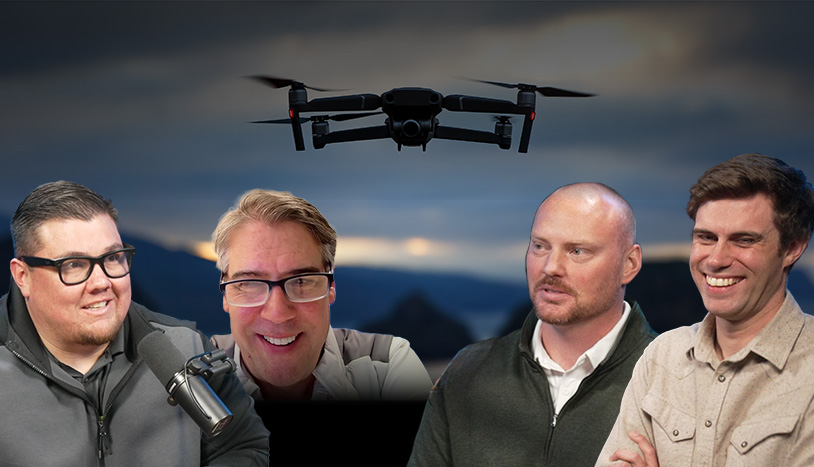
How is reality capture technology changing the way we build? Join Greg Dunkle, STO Building Group (STOBG)’s Chief Operating Officer, Jon Ferguson, Vice President of Virtual Design and Construction at Layton Construction, Austin Lay, Senior VDC Manager at Layton Construction, and James Pipe, Chief Product Officer at Drone Deploy as they explore how tools like drones, 360 cameras, and AI are transforming project accuracy, documentation, and data management on today’s jobsites.
Listen Now
Layton's Approach to VDC
The demand for BIM and VDC solutions is growing stronger every day—and builders need to continue to innovate and evolve to keep up. Join former Public Relations Manager, Bryan Packer, as he discusses Layton Construction’s unique approach to BIM and VDC with the company’s virtual design and construction team: Jeff Metcalf, Vice President of Information Systems, Jon Ferguson, Director of Visualization, and Tim McLachlan, Director of BIM.
Listen Now