
- Artificial intelligence is dramatically increasing data center power and cooling requirements, driving the adoption of liquid cooling technologies.
- Liquid cooling enables AI racks exceeding 200 kW and future systems approaching 500 kW to operate efficiently where traditional air cooling cannot.
- Liquid cooling systems require significant new infrastructure, including coolant distribution units (CDUs), piping networks, thermal storage, dry coolers, and central plant upgrades.
- Early planning is essential to accommodate piping routes, structural loading, equipment yards, and white space layouts.
- Fluid quality management is critical, as contaminants can clog microscopic cooling channels within GPUs and CPUs.
- Leak detection, drip prevention, quick disconnects, and filtration systems become essential components of liquid-cooled environments.
- Construction teams must extend quality control and commissioning beyond mechanical systems directly to the server and chip level.
- OEM manufacturers, including NVIDIA, now establish strict requirements for coolant temperature, flow rates, cleanliness, and system performance.
- Commissioning must validate rapid AI workload fluctuations, ensuring cooling systems respond effectively to sudden spikes in computing demand.
- Retrofitting existing facilities presents challenges related to available space, structural capacity, and operational continuity.
- Successful long-term operations require technicians with expertise in liquid cooling systems, coolant chemistry, leak detection, and CDU maintenance.
AI is driving higher rack densities and heat loads than traditional systems can support. Liquid cooling is the most effective way to remove that heat while improving efficiency and supporting next-generation AI infrastructure.
Traditional racks operate at 10–30 kW, while modern AI racks can exceed 120 kW. These higher densities generate more heat than air cooling can effectively manage, making liquid cooling necessary.
Liquid cooling requires early planning for CDUs, piping, thermal storage, chillers, leak detection, and fluid management, all of which add complexity to data center design.
With direct-to-chip cooling, testing and quality control extend beyond facility systems to the GPUs and CPUs themselves, requiring validation of flow rates, cleanliness, and cooling performance.
OEMs such as NVIDIA have strict requirements for coolant temperature, flow, and cleanliness, making close coordination essential throughout installation and commissioning.
Commissioning must verify system cleanliness, leak prevention, and cooling performance under rapidly changing AI workloads that can spike from zero to full load almost instantly.
New facilities can be designed around liquid cooling requirements, while retrofits require careful planning to integrate new infrastructure into existing operating environments.
Additional piping, coolant, CDUs, and support equipment increase space and weight requirements, making structural capacity and floor loading important design considerations.
Operations teams need training in CDU operations, coolant management, leak detection, and liquid-cooled server maintenance to support long-term reliability.
In this episode of Ask the Expert Series, Terence Deneny explains how artificial intelligence fundamentally changes the design, construction, and operation of mission critical facilities. As AI computing demands continue to rise, liquid cooling is emerging as the only practical solution for supporting higher rack densities while improving energy efficiency and system reliability. The discussion highlights how liquid cooling impacts every phase of a project from early planning and preconstruction through installation, commissioning, and day-to-day operations. Success depends on careful coordination between designers, contractors, equipment manufacturers, and facility operators to ensure cooling systems meet increasingly stringent performance requirements. Whether building a new AI-ready facility or upgrading an existing data center, the episode reinforces the importance of proactive planning, infrastructure flexibility, and specialized expertise. As AI continues to reshape digital infrastructure, organizations that understand these evolving requirements will be better positioned to build resilient, scalable, and future-ready data centers.


Terence Deneny has over 30 years of experience managing the design, engineering, construction and commissioning of critical facilities and infrastructure for hyperscale cloud providers, colocation providers, financial service institutions, telecommunications, healthcare and Fortune 100 clients across the globe.
For the past 20 years, Terence has served as vice president of STO Building Group’s Mission Critical sector, providing specialized expertise ranging from needs assessments, site selection and design through commissioning and operations of critical facilities and data centers. Working with owners, consultants, engineers and service providers alike, Terence’s diverse background includes both the networks/telecommunications industry and the design and construction industries. During Terence’s time at STO Building Group, the organization has been consistently ranked in the Top 5 Data Center Builders by Engineering News Record.
The post-pandemic data center boom isn’t slowing down, so how are hyperscalers, builders, and manufacturers keeping up? Join STO Mission Critical Project Executive, Jim DiNoia, as he discusses the influx of mission critical work with SVP of STO Mission Critical, Martin O’Neill, and Vice President of Data Center Engineering at Sentinel Data Centers, Nick Marzorati.
Listen Now
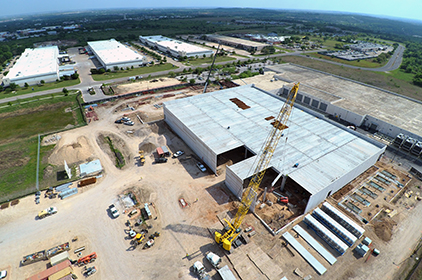
In the fast-paced world of mission critical construction, speed matters—and builders everywhere are looking for game-changing solutions that will help them deliver on cost, quality, and schedule. Join Grant O’Neal, Operations Manager for STO Mission Critical in Dallas, Brett Skyllingstad, VP of Business Development for Structure Tone Southwest, Chris Shackelford, Project Executive for Structure Tone Southwest, and Al Jaurez, a Helix Steel expert, as they explore the mission critical market in Texas and an innovative approach to concrete reinforcement.
Listen Now