

What do Our BIM Experts Say About the Human vs. AI Debate?
By Alice Bodill-Maher, Marketing Manager, Structure Tone London
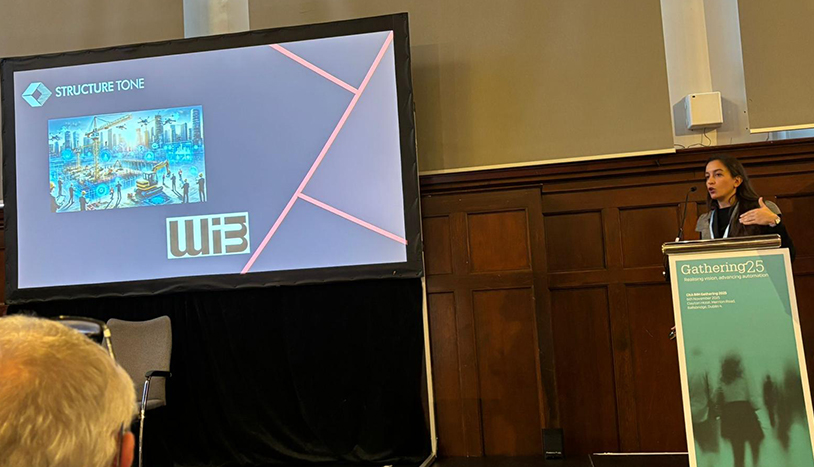
Our Digital Lead Francesca Lofiego headed to Dublin to speak at the annual BIM Gathering Conference, hosted by CitA – a key player in the digital construction space.
The event pulled in big names from the BIM and AECO (Architecture, Engineering, Construction and Operations) world to discuss how tech is changing design, planning, manufacturing and delivery within the built environment.
“AI can tell the story, but only humans can add colour and meaning”
Alongside keynote speeches, the conference’s breakout sessions showcased real-world applications of emerging tools and how to better utilise existing platforms while testing new tech.
One piece of tech at the forefront of everybody’s mind: AI. Francesca took to the stage to share her thoughts on how this is shaping the future of BIM and AECO. Her key takeaway? “AI can tell the story, but only humans can add colour and meaning.”
Francesca praises initiatives like Women in BIM (WIB) for keeping collaboration and inclusion at the heart of digital transformation. She adds: “Amidst this rapidly evolving tech world, it’s crucial to remember the human touch, something we continue to champion through our Women in BIM organisation.”
The four biggest challenges facing digital construction
Francesca also highlighted some of the key factors slowing down digital adoption in construction:
- Industry fragmentation – too many stakeholders, too many different levels of digital maturity
- Cultural shift – tech isn’t just tools, it’s mindset. We need champions who can communicate value and drive change
- Skills shortage – construction and tech rarely mix in people’s minds, leaving gaps in roles like BIM managers and digital leads
- Handover-to-maintenance gap – even with rich models, clients often don’t know how to use the data for better building performance

To combat these challenges, clear standards and better data interpretation are critical, especially around the LOD (level of development) and BIM mandateGo to https://bimforum.org/resource/lod-level-of-development-lod-specification/. Francesca adds that: “Industry experts also have a duty to educate clients and colleagues on how this data can be used to improve building performance, reduce operational costs, and contribute to the UK’s Net Zero 2050 targets.”
Is AI the answer to all our problems?
Can AI help us overcome the challenges we face in digital construction? The answer is probably yes. But only if we have the right skills and mindset.
Right now, construction ranks near the bottom for AI adoption, according to a recent U.S. report. That’s why leaders like Francesca stress the need for ongoing education and advocacy.
At Structure Tone, we are testing predictive AI to analyse site images and forecast project milestones, helping teams spot delays before they happen. Across the industry, consultants and contractors do utilise AI, but from her experience working across both environments, Francesca has noticed that AI is used very differently.
She comments: “Consultants typically use AI for generative design, space planning, and structural analysis, while contractors apply it to project planning, safety, and cost estimation. Interestingly, both sides are finding value in using AI for sustainability and bid preparation.”
Three types of AI revolutionising construction:
- Generative AI
- Predictive AI
- Reasoning AI
“The latter is still emerging but expected to become standard practice soon,” Francesca adds. “But while all these AI mediums can report, analyse and optimise, like all AI platforms, human creativity and perspective cannot be replaced.”