United States

Podcast Episode
Ask the Expert: Rethinking Mass Timber with DFMA with Pete Kobelt
July 10, 2026
What is Design for Manufacturing and Assembly (DFMA), and why is it becoming a gamechanger for mass timber construction? In this episode of Ask the Expert, Pete Kobelt, Director of Mass Timber Solutions at STO Building Group (STOBG), answers listener questions about how DFMA is transforming project planning, manufacturing, and delivery.
Key Takeaways
- DFMA (Design for Manufacturing and Assembly) leverages off-site prefabrication to improve efficiency and project outcomes.
- Mass timber components are manufactured in controlled factory environments and assembled rapidly on site.
- DFMA can accelerate construction schedules by 20% to 25% compared to traditional building methods.
- Prefabrication helps address labor shortages by reducing on-site workforce requirements.
- Digital modeling and shop drawing coordination reduce project risk and improve predictability.
- Successful mass timber projects require stakeholder engagement early in the planning and design process.
- Strategic partnerships and specialized expertise help streamline design, engineering, and construction workflows.
- DFMA can support sustainability goals by improving material efficiency and reducing waste.
- Not every project is a good fit for mass timber, making early evaluation and business case development critical.
- Education and collaboration help owners make informed decisions about whether mass timber is the right solution for their project.
Highlights In This Episode
DFMA (Design for Manufacturing and Assembly) shifts much of the construction process off-site, using prefabrication and detailed planning to improve efficiency, quality, and coordination compared to traditional, field-built approaches.
By allowing fabrication and site work to happen in parallel, DFMA compresses timelines and enables faster, more streamlined installation once materials arrive on site.
Key benefits include shorter schedules, reduced labor needs, improved quality control, greater cost certainty, and more predictable project outcomes.
Prefabrication reduces the amount of skilled labor required on site and shifts work to controlled factory settings, helping teams navigate ongoing labor constraints.
Advanced modeling and detailed coordination help identify and resolve potential issues early, minimizing errors, clashes, and costly rework during construction.
Planning should start as early as possible—ideally during the conceptual or schematic design phase—to fully realize the benefits of DFMA.
Engaging all stakeholders early ensures alignment, reduces surprises, and allows for more accurate budgeting and scheduling from the outset.
Mass timber projects require specialized expertise, so having experienced partners helps streamline design, engineering, and construction while avoiding costly missteps.
It demonstrates how early planning, strong coordination, and the right partnerships can successfully scale DFMA principles on complex, real-world projects.
Clients should evaluate feasibility, cost, schedule, supply chain considerations, and whether the project aligns with their sustainability and performance goals.
Because DFMA requires upfront planning and coordination, teams must fully commit early on to realize its efficiency and performance benefits.
By assessing factors like building type, location, budget, timeline, and sustainability goals early in the process to determine overall fit and value.
Closing Summary
In this episode of Ask the Expert, Pete Kobelt, Director of Mass Timber Solutions at STO Building Group (STOBG), explores how Design for Manufacturing and Assembly (DFMA) is reshaping the delivery of mass timber construction projects. Through practical examples and listener-driven questions, Pete explains how prefabrication, digital planning, and early stakeholder engagement can improve schedule certainty, reduce labor demands, and enhance project outcomes. He also shares insights from a large-scale mass timber development in Arkansas and offers guidance for owners evaluating whether mass timber is the right fit for their next project. The conversation highlights the importance of education, collaboration, and strategic planning in unlocking the full value of DFMA.
Host


Pete Kobelt
Director of Mass Timber Solutions
STO Building Group (STOBG)
Pete Kobelt is STO Building Group (STOBG)’s Mass Timber Practice Lead. He has been engrained in the exploration and adoption of mass timber in the US & Canada since its early days, contributing to the conception and establishment of the first CLT manufacturing plant in the US, the construction of three additional plants, and the first and largest mass timber student housing project in the US, among many other projects. Today Pete has helped deliver nearly 2M SF of Mass Timber projects in North America.
Pete’s passion for mass timber stems from his time helping to start and build three craft breweries in Seattle and Whitefish, Montana in the 1990s. The complexity of their design, construction, and operation led Pete to study new, innovative, and more sustainable construction techniques. As a dual US/Swiss citizen with family ancestry in Swiss forestry, Pete was able to spend time in Switzerland, Austria, and Germany, studying the dramatic advances in engineered wood manufacturing and construction and the subsequent advent of mass timber. With the gracious support of his European colleagues, Pete was part of a team that imported the first commercial mass timber project to the US in 2011. Many years later, mass timber construction is disrupting the industry and helping provide a cost effective path to sustainability for the built environment.
Similar Episodes
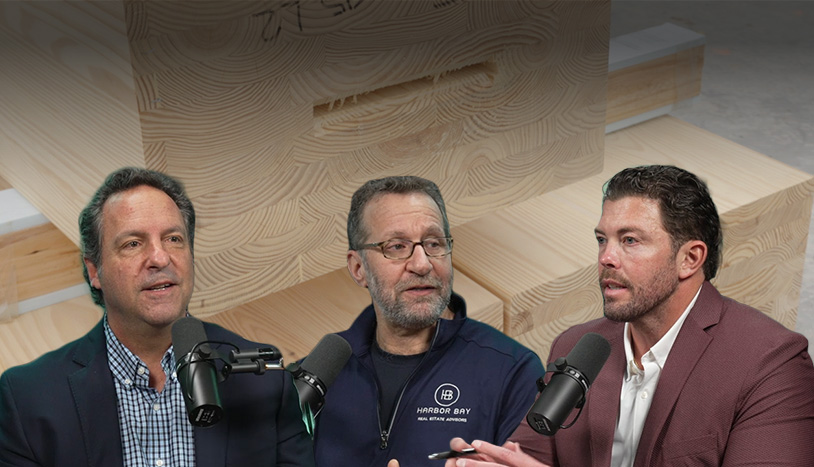

Stacking the Deck: The Rise of Mass Timber in Modern Building

Could mass timber be the catalyst for the next era of construction efficiency and sustainability? Join Doug Kroll, Director of Business Development at Layton Construction, Pete Kobelt, Director of Mass Timber at STO Building Group (STOBG), and James Litwin, Vice President of Construction at Harbor Bay, as they dissect how this groundbreaking material is streamlining project delivery, enhancing design flexibility, and reducing environmental impact.
Listen Now
Mass Timber Construction: The Carbon Sequester
From the embodied carbon associated with construction materials to the operational carbon produced throughout a building’s lifecycle, the design and construction industry has the opportunity to make a big impact when it comes to carbon. Join STO Building Group (STOBG)’s director of sustainability, Jennifer Taranto, as she interviews two subject matter experts: David Briefel, sustainability director and design resilience leader at Gensler, and Jeff Morrow, president of J. Morrow Solutions, as they discuss the ingredients of net zero carbon buildings and how mass timber construction can fit into the equation.
Listen Now